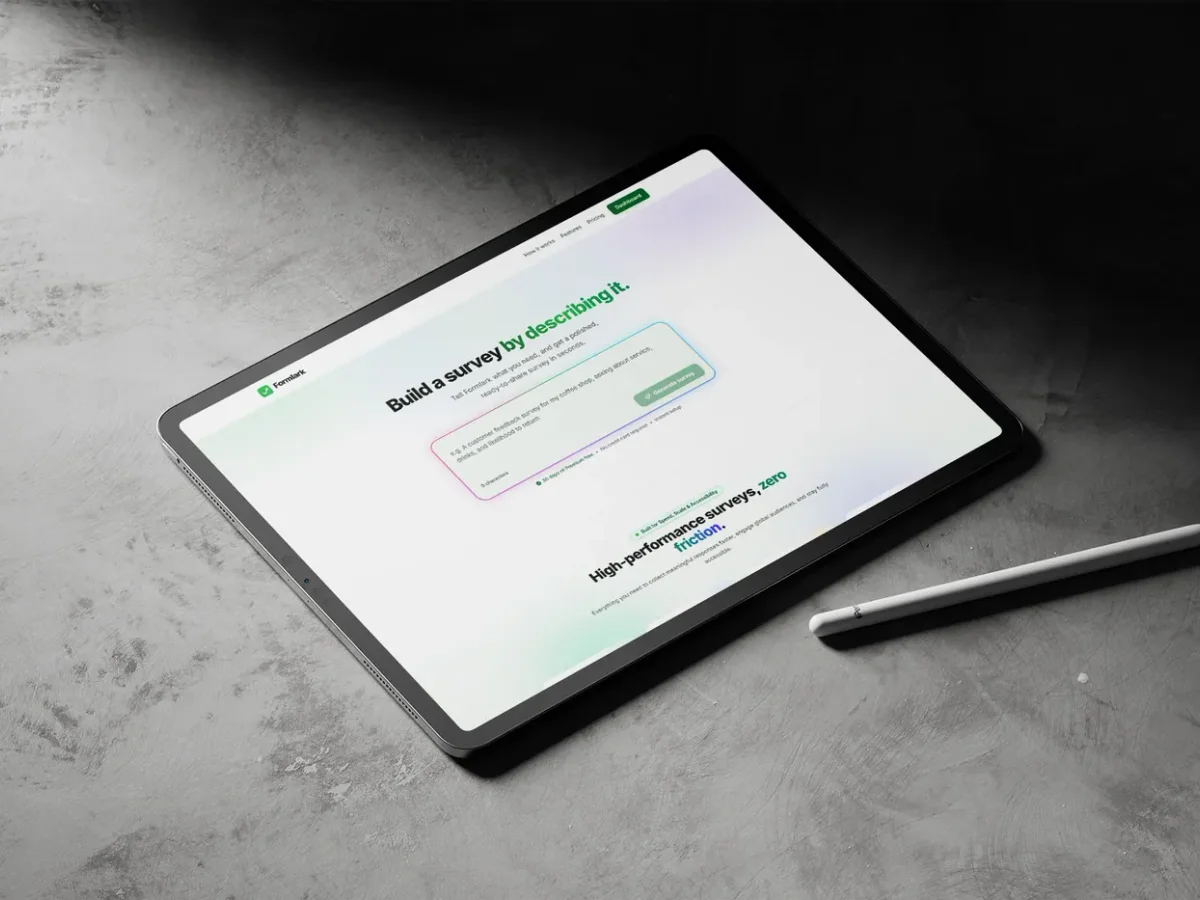
The problem
Generating a survey quickly does not make it ready to send. Someone still has to read the questions, check the logic and decide whether the result says what they intended. A review flow can easily consume the time that AI generation saved.
There are also two different users. Authors need control over questions and branching. Respondents need a short, clear path to completion. Giving one side more power should not make the other side work harder.
Constraints that shaped the work
The product needed to support more than fifty languages, including right-to-left layouts, alongside a WCAG 2.1 AA accessibility commitment. Text expansion, direction changes, keyboard use and screen-reader labels had to be part of the system rather than exceptions added to individual screens.
Make the draft the working surface
The generated survey opens as an editable document. Authors read and change the questions in the same place, instead of reviewing them through a separate wizard. This keeps the review attached to the actual result.
Question-level rewriting and tone changes sit beside the question they affect. The decision gives AI a clear role: produce a useful starting point while keeping the author in control of the wording.
Show the route through the survey
Branching is presented as a visible flow attached to the relevant question. A rule table can be compact, but it asks the author to reconstruct the respondent's path mentally. Showing that path uses more space in exchange for making the logic easier to inspect.
The respondent experience uses one question at a time and visible progress. The builder holds the complexity so the person answering does not have to.
Keep the evidence beside the explanation
Results lead with charts, with the AI-generated narrative beneath them. The summary can help someone enter the analysis, but it does not replace the numbers they need to check.
Design and implementation scope
My published scope covers product design and the design system. Accessibility behaviour belongs in the reusable components, while logical layout properties support direction changes.
Outcome and further questions
The resulting experience brings draft review, editing and branching into the working document. Respondent screens inherit accessibility and language support from the system.
The published account describes the change qualitatively. It does not supply a measured before-and-after completion rate. Reviewing author correction rates and respondent drop-off across languages would be useful evidence for the next iteration.